Four chords, hundreds of hits
Hack your piano progress with a simple progression you’ll use again and again and again…
Way back at the dawn of the internet (okay, not really, but 2011 does feel like a long time ago), a video by Australian comedy group The Axis of Awesome went extremely viral. In it, the group ponders the idea that “all the greatest hits from the past forty years just use four chords — the same four chords for every song.”
Is it true? Not quite, but the group makes their case in a compelling and catchy way, tearing through a medley of memorable choruses from the worlds of rock and pop at lightning speed. You can watch it below, and we highly recommend you do:
So what’s going on here? Well, the band has stumbled upon the I-V-vi-IV progression: the root, the fifth, the minor sixth, and the fourth. Played in any key, it just works, for lack of a better explanation. Individual notes flow neatly into one another, it resolves in a satisfying way, it’s simple enough to remember, and ambiguous enough that your melodic and rhythmic options remain wide open — as evidenced by the range of styles on display in the Axis of Awesome’s performance.
We’re not literally saying that all these songs just use these four chords in exactly this order (though some do). Many songs feature it just at key moments in a verse or chorus, others might substitute one chord in the sequence or add a little variety by extending the others, and there are also plenty of songs that follow the same sequence, but starting on a different chord — V-vi-IV-I, for example. Among the artists to have made good use of this progression, or a close variation of it are The Beatles, U2, Beyoncé, Taylor Swift, Maroon 5, Coldplay, Adele, and many more.
The best part? It creates an opportunity to take a sneaky shortcut in our piano learning. So pay close attention, this may be the most useful chord sequence you’ll ever learn.
A note on numerals
You might be used to seeing chords written out as letters, so what are these Roman numerals doing? It’s just another way to talk about the same thing, independent of key. Roman numeral analysis, as the system is known, helps us see how the chord functions within its key by relating it back to the root, or I, chord. We can play a G major chord in lots of keys, for example, but knowing that it’s the V chord in the key of C major tells us a little more about how it works in this particular context.
One important detail: When you see the numerals in capital letters, that’s a major chord. If you see them in lowercase, it’s minor. Read on to learn more about both.

How to play major triads
Ready for a couple of quick practical lessons? They’re very simple, and all you really need to know before tackling the tracks below. We’re going to need two kinds of three-note chords or “triads”: major and minor.
To play any major chord, just find the root note on the piano. That’s the one the chord is named after, so C in the example above. Need help finding it? The black keys are clustered in alternating groups of two and three. The white notes immediately to the left of the groups of two are all C. “Middle C” is the C right in the center of your keyboard, and it’s a great place to start for playing chords.
Count up four keys from middle C, black ones included, and you’ll land on E. This is our “major third” and it’s what gives the chord a “happy” feel. Count up three more keys from here, and you’ll be playing a G. This is the fifth of the chord. It has a more neutral flavor, but reinforces the root note in a very “stable” and consonant way.
Play them all at the same time, and that’s C major. While you will need to adjust your fingers into different shapes to play other major triads, you can still count out the notes in the same way.
How to play minor triads
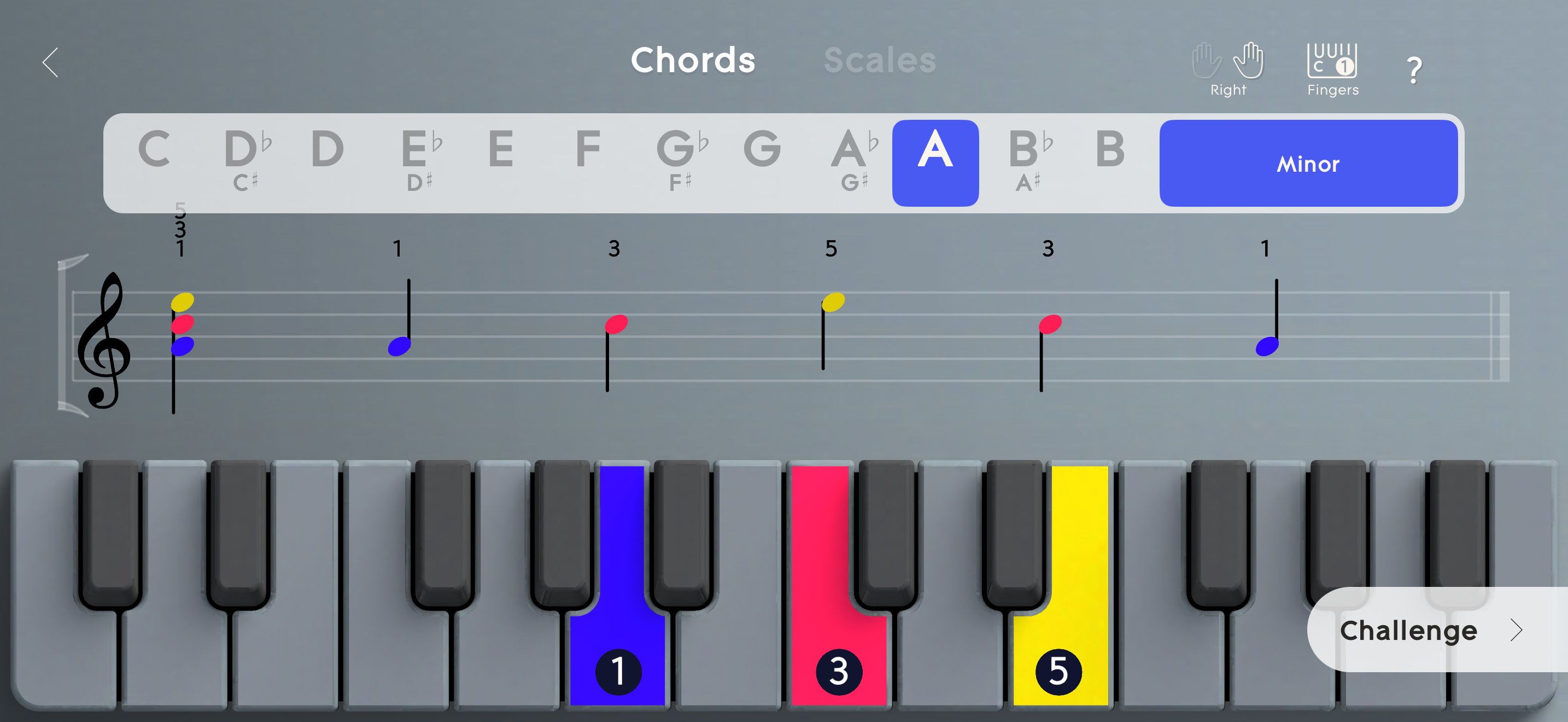
Minor triads work in a very similar way — we just play the first, third, and fifth notes relative to the root of the chord. The difference is that we have a minor third, not a major third. Remember how this is what gave our major chord a “happy” feel. “Flattening” the third, moving it down one semitone (or one key on the piano), gives a chord a “sad” feel.
We can use the same counting technique to find the notes for any minor triad we need, but the intervals — the gaps between the three notes — are reversed. We start with the root, count up three keys to find the minor third, and then four more keys from here to find the fifth. The fifth is what’s known as a “perfect” interval; it’s neither minor nor major, and it’s the same in both the minor and major varieties of any given triad.
In the key of C major, the vi chord is A minor, so you’ll want to find the A, C, and E keys on your piano.
Four songs you can play with just four chords (and ROLI Learn)
Ready to put the theory to the test? Here are four songs you can pretty much play with the same four chords: I, V, vi, and IV, in that order. They’re all in different keys, but we’ll let you in on a little secret… you’re allowed to play them in whichever key you like best (or the one that’s easiest to sing along with, should you be feeling inclined to do so).
U2 — With Or Without You
Often cited as the quintessential four-chord song, much of “With Or Without You” doesn’t really feature “chords” the way we typically play them on piano: The bass runs through a “loop: of the four root notes that varies little over the track’s near-five-minute length, while the guitar holds sustained notes over the top — with the repetition creating a hypnotic effect that was far more common in electronic music at the time. The sequence, D-A-Bm-G, is largely implied by the interplay of Bono’s vocal melodies and that bassline.
Jason Mraz — I’m Yours
Another “pure” I-V-vi-V song, “I’m Yours” has been a fan favourite for nearly two decades at this point, putting it firmly in the nostalgia category for anyone old enough to remember its 2008 release. The official video currently sits at over 900 million views, and we wouldn’t be surprised to see it hit a billion in time for the song’s 20th anniversary. Not bad for a song reportedly written in under 20 minutes. To play along with it, you just need to take the chords you’ve learned for “With Or Without You”, drop them down three semitones each, and adopt a relaxed reggae rhythm.
Alicia Keys — No One
In an article about playing pop songs on piano, it’d almost be rude not to mention Alicia Keys. As with “I’m Yours”, Keys has reportedly said that this song came together very quickly and effectively “wrote itself”. Aside from a little reshuffling in the bridge (best just cross that when you get to it in the app), “No One” uses — surprise — the exact same chords as the previous two songs. This time we’re in E, so take your U2 sequence and move everything up two semitones. If you’re feeling brave, try to feel out the arpeggios while playing along.
Adele — Someone Like You
We’re breaking the rules with this one — you’re going to need an extra chord, unfortunately. But it’ll be worth it; there’s almost no better demonstration of the full power of the I-V-vi-IV progression. The trick here is that it doesn’t appear until the chorus. The verse swaps the V chord, which is E in this case, for the iii, which is C#m. They share two notes, E and G#, but function quite differently. The verses feel more intimate and subdued, before the cathartic chorus raises the roof with a lot of help from Adele’s soaring vocals.
Learn hundreds more hit songs with ROLI
Ready to learn the finer details of all of the above songs and many more besides? Start in the best possible way with a piano-learning setup from ROLI. Buy ROLI Piano or Piano M with Airwave, and not only will you save on the bundle, but you’ll also unlock AI-powered conversational feedback that helps you perfect your technique and progress at a pace that’s right for you.
Suggested articles
28 new two-handed lessons in the ROLI Learn app



Why reading sheet music is overrated (and what to do instead)

ROLI Experiments: Can you learn piano if the teacher can’t see your hands?

Discover thrilling ROLI Learn arcade games

From Guitar Hero to ROLI Piano: How rhythm games became real music learning.
Halloween hits in the ROLI Learn app

Head back to 2016 with the biggest hits in the ROLI Learn app
Join the ROLI community