Leonardo ‘The Space Pianist’ Barilaro on playing Piano M in zero gravity
The aerospace engineer and composer talks recording an EP mid-flight, why MPE expression survived the loss of gravity, and his plans to take a piano all the way to Mars.
While many musicians worry about the acoustics of a room when it comes to music performance, Leonardo Barilaro has had to worry about the absence of gravity. An aerospace engineer who researches space debris by day and a concert pianist and composer by calling, Barilaro — better known as "The Space Pianist" — has spent nearly two decades fusing scientific rigor and artistic expression. In November 2025, he took that experimentation to its most literal extreme yet, recording an EP aboard a parabolic flight on the ROLI Piano M, aptly performing the Star Wars theme.
Now, we at ROLI HQ pride Piano M for its portability and ability to capture creative expression anywhere, but we had never envisioned anything quite like zero gravity piano playing. We sat down with Leonardo to talk about what it feels like to play when your hands float above the keys, how he's fusing live space telemetry with performance, and why he believes the future of space travel needs to save a seat for artists.
Could you introduce yourself and tell us about your background?
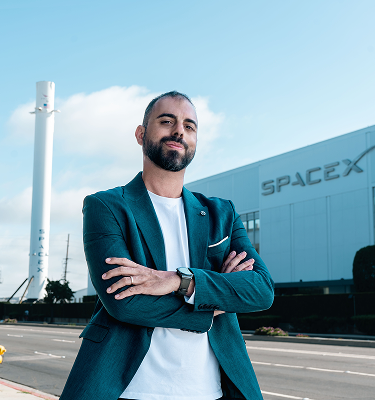
“Ciao! I am Leonardo Barilaro, also known as The Space Pianist. I have navigated a dual path throughout my life, merging my expertise as an aerospace engineer, researching space debris and hypervelocity impacts, with my creative journey as a professional pianist and composer. My work is fundamentally transdisciplinary. Designing a resilient bridge between science and art has been my central mission since 2006, driven by the core philosophy of 'Music from Space'. I have had the honor of sending my music to space three times, broadcasting it directly from the International Space Station back to Earth. My path has taken me from academic research to recording music during a zero-gravity flight, always exploring how scientific rigor and advanced artistic expression can intersect in synergy. As I look to the future, this exploration is reaching a new level. This autumn, I am launching a new polymathic hub, the Space Art Lab at NYU Abu Dhabi, creating a dedicated home for this unique convergence.”
You go by the title "The Space Pianist." How did a passion for music and a fascination with space first collide for you?
“It was an organic progression. By the age of six, I was inseparable from the piano, and a few years later, I was equally captivated by astronomy. By the age of 12, immersed in the works of Isaac Asimov, my path became crystal clear: I decided I would become an aerospace engineer and a pianist, to travel to space and play my music from orbit. I never saw a boundary between science and art. 'The Space Pianist' is not a constructed alter ego; it is the truest reflection of my transdisciplinary approach. My goal has always been to elevate human expression alongside our technological advancements. Sending my music to the ISS was the first real step into space, marking the dawn of a lifelong vision. When recording acoustic compositions destined for space, I rely exclusively on Steinway grand pianos. It is a deliberate choice to match the technological marvel of spaceflight with the pinnacle of acoustic craftsmanship, ensuring that humanity's highest artistic resonance echoes in the cosmos.”
What does it actually feel like to play piano in zero gravity? Did your hands, the keys, or your whole sense of timing behave differently than you expected?
“It completely shatters your terrestrial understanding of the instrument. During the parabolic flight in November 2025 — a collaboration with the team at G0 Flight to record my EP Zero Gravity, Note One — I quickly realized how much we depend on gravity as a rhythmic anchor. Without it, the physical feedback loop is severed. You have to actively secure yourself, and your hands essentially float above the keys. The transition from the heavy hypergravity phase directly into weightlessness forces you into a state of hyper-awareness. It was a remarkable challenge that demanded real-time problem-solving, both musically and physically.”
It's quite interesting that you decided to play Piano M in a zero-gravity setting. Was it the portability, or something else, like the specific features it had, that made it the right instrument to play?
“The physical constraints of a parabolic flight dictate your instrument choices. The ROLI Piano M was the perfect solution, primarily for its unmatched portability and the flexibility and modularity it offered in such a restrictive environment. However, another critical factor was the MPE technology. Because traditional dynamic control via gravity is lost, the pressure sensitivity of MPE allowed me to maintain expressive control, shaping the sound waves continuously. From a research perspective, it was also invaluable: we retrieved the playing data in real time and fused it with the camera data to analyze the mechanics of playing in a weightless environment. To bring this data full circle, I will be presenting the academic findings of this unique experience at the International Symposium on Electronic Art (ISEA2026) in Dubai this November.”
We know that the Piano M's keys respond to pressure in a very particular way. Did floating freely change how you used that expressivity, and did weightlessness unlock anything musically that you hadn't found before?
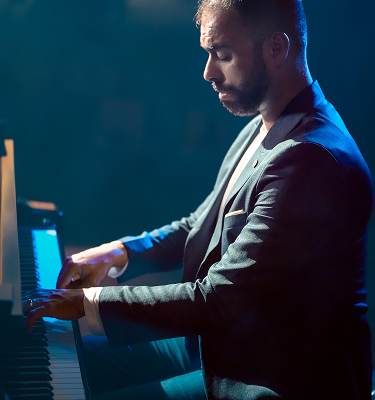
“Our kinematic data analysis revealed that floating freely completely shifts how you approach pressure. Without gravity, you lose the ability to rest your arm weight into the keys, which directly results in lighter initial key attacks and reduced stability in continuous downward pressure. To counteract my arms drifting upward, I had to actively engage my latissimus dorsi and triceps muscles just to stay anchored to the Piano M, but rather than just being a limitation, this biomechanical inversion unlocked something new musically: it forced a move away from gravity-dependent, percussive techniques. The environment naturally guided me toward a fluid, floating aesthetic that utilized MPE for lateral sliding gestures and highly sustained sonic textures. A prime example of this is 'SCRAT', a long lead solo from the EP recorded during the flight. The track is a tribute to the music I created for my first real space project in 2010.”
What hopes do you have for the future of music-making and space travel? It seems like you're leaning into bigger ideas about limitless creativity, exploration, or human expression.
“We are entering a phase where space travel must evolve beyond pure survival and scientific observation; it needs to become a fully realized cultural endeavor. As we lay the groundwork for habitats beyond Earth, art and music will become vital lifelines for processing the overwhelming magnitude of the extraterrestrial experience. To bridge this gap, I am deeply interested in how we can use the environment itself as a medium — for example, developing transdisciplinary works where complex space data and the unique environment of low Earth orbit are synthesized into a cohesive audiovisual experience, directly fusing these cosmic mechanics with my acoustic piano and synthesizer compositions.
This philosophy of turning physics into human expression is the core focus of my upcoming research presentations at the International Astronautical Congress (IAC 2026) in Antalya later this year. I hope that the future of space travel inherently reserves a seat for artists in orbit. Experiencing the Overview Effect completely alters human consciousness, and we need artists up there to process that profound paradigm shift. By doing so, they can translate the majesty of the cosmos into entirely new musical forms that will define the culture of our multi-planetary future.”
You shared a sneak preview of some work that you've begun with the ROLI Piano M and Airwave called 'Orbital Refractions'. Could you tell us more about that?
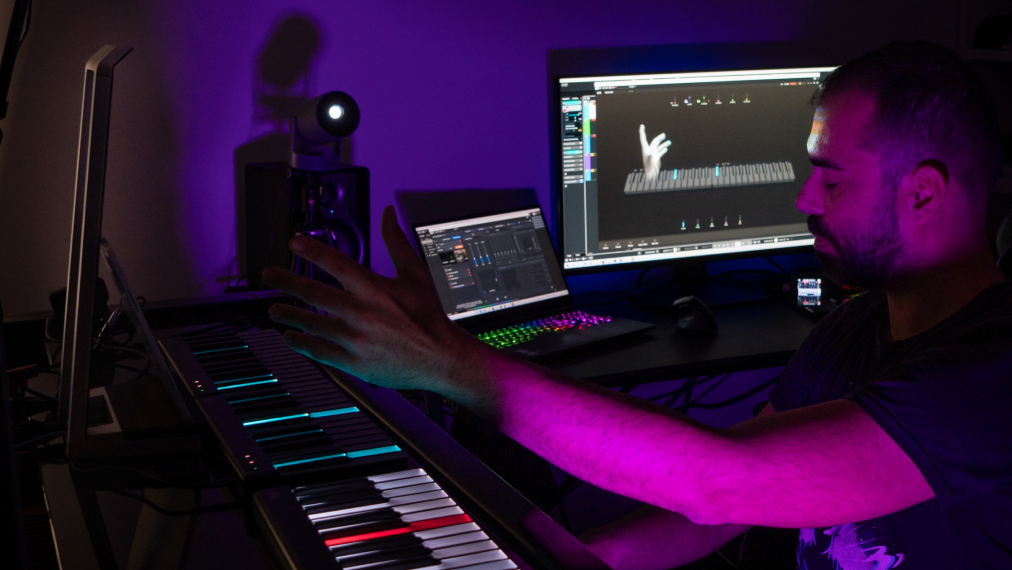
“'Orbital Refractions' is an exciting, interdisciplinary collaboration with the brilliant visual artist and creative director Laura Alice Bracken. It is an experiential exploration of cosmic interconnectivity designed to make space data perceptible and emotive. We are synthesizing high-fidelity scientific telemetry — including space debris data and satellite outputs — with immersive, generative visual environments in real time. I pair the tactile MPE capabilities of the Piano M with the spatial hand-tracking of the Airwave, allowing me to pull the sound off the keys and shape frequencies in 3D space. These gestures then drive the dynamic visuals. It is a highly experimental project bridging ancient navigation with digital, algorithmic futures, blurring the lines between science communication, musical performance, and digital art.”
Performing in zero gravity is quite a remarkable achievement in and of itself, so what is your next goal? Are there future ambitions for musical performances or music creation in space?
“The zero gravity recording was just one step in a much larger trajectory. Next, I aim to take the piano into orbit, inspired by performances like Sarah Gillis's on the Polaris Dawn mission. Looking further ahead, the goal is to perform on the Moon and, ultimately, to give a live concert on Mars broadcast back to Earth.
In the meantime, I am channeling my energy into my upcoming tenure as a Visiting Associate Professor at NYU Abu Dhabi. This role is where I will bring the Space Art Lab to life, bridging the gap between education and extraterrestrial research. I am also preparing for the second edition of my book, Music from Space, which will be released this autumn, detailing the complete framework behind this mission.
In parallel with reaching the stars, my mission is to inspire and train the younger generation, continuing to develop space projects and activities right here on our pale blue dot, planet Earth.
The journey is just getting started. See you up there!”
From a six-year-old inseparable from the piano to a composer broadcasting his music from the International Space Station, Leonardo Barilaro is on a mission to blur the boundary between science and art, and he has no intention of stopping at performing in zero gravity. This autumn, the Space Art Lab launches at NYU Abu Dhabi, and a second edition of Music from Space follows. With ambitions that stretch from Earth all the way to a live concert on Mars, Leonardo’s journey is, in his own words, just getting started.
You can follow Leonardo's work at thespacepianist.com and on Instagram @thespacepianist.
Share your Piano M adventures
Where’s the wildest place you’ve taken your Piano M? Show us where your creativity takes you this summer, and tag us on socials at @roli_create or @roli_learn.
Suggested articles
As seen on TV (and elsewhere): ROLI Piano and Airwave in the wild

New Year, new you: beat the brain rot
Best digital pianos & keyboards for beginners: Your 2026 buying guide
From Guitar Hero to ROLI Piano: How rhythm games became real music learning.
Join the ROLI community