Birth of the Beat: A brief history of sampling in hip-hop
How musical mistakes and innovation became one of the most influential genres in history.
Music history has never been short of stories about era-defining genres being discovered by accident. In honor of Black History Month, we wanted to take a closer look at the history of hip-hop and how innovations with synthesizers and samplers, and a few happy accidents, formed a genre that ingrained itself in popular culture and revolutionized contemporary music as we know it.
Going back as far as the 60s, the ability to sample audio has existed in instruments like the Mellotron, which used tape samples to produce its sound. The next great sampling advancement came in the form of the Fairlight CMI. Released in 1979, it was one of the earliest digital synthesizers, digital audio workstations, and samplers, and it’s credited with coining the term ‘sampling’ as we know it today.
But hip-hop’s origins didn’t start with synths and drum machines; the ubiquitous sampling sound we all know and love began with vinyl records in the streets of New York. Rooted in many of the same DIY principles as house music that quickly came to prominence in the same era, there was a shared language of innovation beyond limitation, using the gear they had to hand to achieve the sounds ricocheting around their minds in whatever way they could.
Birth of the Beat
Hip-hop's foundations can be traced back to the breakbeats and turntablism of the late 70s, and the turntable mastery of DJ Kool Herc. Hailing from Jamaica and having grown up on the dance hall music intrinsic to the culture, DJ Kool Herc, also known as Clive Campbell, emigrated to New York as a teenager in 1967. His early days as a DJ were marked by hard funk and R&B records, and using a two-turntable setup, Kool Herc’s mixes emphasized the instrumental portions of the records he spun. By using two copies of the same record, he was able to isolate and extend cherry-picked drum breaks, with Campbell rapping over the top. This typified the breakbeat sound and became the backbone of early hip-hop and the crucial soundtrack to the lives of b-boys and b-girls. Kool Herc's distinct style quickly grew in popularity, adopted by the likes of Afrika Bambaataa and Grandmaster Flash, who would push the new sound of hip-hop into the spotlight.
But as hip-hop’s sound developed, it would see another seismic sonic shift in the 80s with the work of producer Marley Marl. Another name often credited with laying the foundation for the sound of hip-hop, Marley Marl’s innovative approach to sampling blew the doors wide open for what hip-hop could be. He did not limit himself to the digital samples that came with the samplers. He realized he could take snares, kicks, and hi-hats from his vinyl records, sample them, and create his own to make beats. The KORG SDD 200 was not just for the instruments themselves, as was common among most producers of the time; instead, he used it to trigger whole song loops.
"I was actually trying to get a riff off of a record. I made a mistake and got the snare in there before the sound came," Marl recalls. "I was truncating the vocal part but the snare was playing with the beat — we was truncating while the beat was playing. Thank God the beat was playing, because it probably wouldn't have happened if the beat wasn't playing. So I was playing it and the snare sounded better than the snare that I had from the drum machine when I was popping it."
Roland as the foundation
Early hip-hop pioneers were really putting synths and samplers through their paces, and Roland drum machines were heard across hundreds of productions. Much like their house music counterparts who favored instruments like the Roland TR-909 and TB-303, hip-hop producers found endless inspiration in the TR808. Close competitor to the very pricey Linn LM-1, the TR808 was an accessible alternative using synthesized digital drum samples in contrast to the LM-1, which used real instrument samples.
The Linn-fluence and AKAI MPC
Roger Linn needs no introduction, but just for those who are unfamiliar with the name, Roger Linn is the hugely influential designer behind the Linn LM-1 and legendary LinnDrum drum machines, used across countless records by artists such as Sting, Prince, Michael Jackson, Queen, and Billy Idol.
His later collaborations with Japanese electronics manufacturer, AKAI, further expanded his touch across the music industry with the development of the AKAI MPC. Where the Roland Drum Machines had limitations, the MPC unlocked the imaginations of any producers who put time into it. Taking the foundations that DJ Kool Herc had laid by extending instrumental portions of inspiring records in an endless loop, and Marley Marl’s technique of creating bespoke samples out of instruments found in those records, the hip-hop sound was solidified; a musical tapestry made of the sounds of the past, but unquestionably the sound of the future.
Yet, despite all the newfound trickery that came with more hi-tech gear, there were still producers who preferred the simplicity and spontaneity of human touch. One such producer was J Dilla, who quite famously used an AKAI MPC3000 with the quantise feature disabled. His productions steered away from ‘on the grid’ quantizing, resulting in a sound that seemed to emphasise humanisation. J Dilla’s signature mixture of straight rhythms with a swung style went on to shape the sound of much of contemporary hip-hop production. It even influenced the way traditional drummers played, most notably Questlove, who remarked that the beats “sounded like the kick drum was played by like a drunk three-year-old,” but was so enamored with the style that he incorporated it into his technique.
Roger Linn recalls the innovation that came from artists using his instruments and pushing them in directions he never anticipated. When the MPC 60 was made, it contained 26 seconds of sampling time; however, new developments in production and sampling techniques would signal a need for more, up to 3 minutes worth, so that they could have a canvas to build the songs they envisioned, using whole measures of songs as the foundation. “I can make the brush, but it’s the artist who decides what to paint with it, and Dilla surprised me, sampling loops surprised me," he said. "That’s what the artist does in our culture. The artist makes a vector, knows what should be done, and makes that vector, and then everybody follows them. I can try my best to predict it, but it always surprises me.”
Sampling for the future
From vinyl-spinning DJs like DJ Kool Herc stretching breakbeats in the Bronx to J Dilla reshaping rhythm on the AKAI MPC, hip-hop showed the world how to turn limitation into innovation. Over here at ROLI HQ, we’re still keeping the rule-breaking spirit of sampling alive, paying homage to the forefathers, and looking at new ways to sample and perform our own beats for the future.
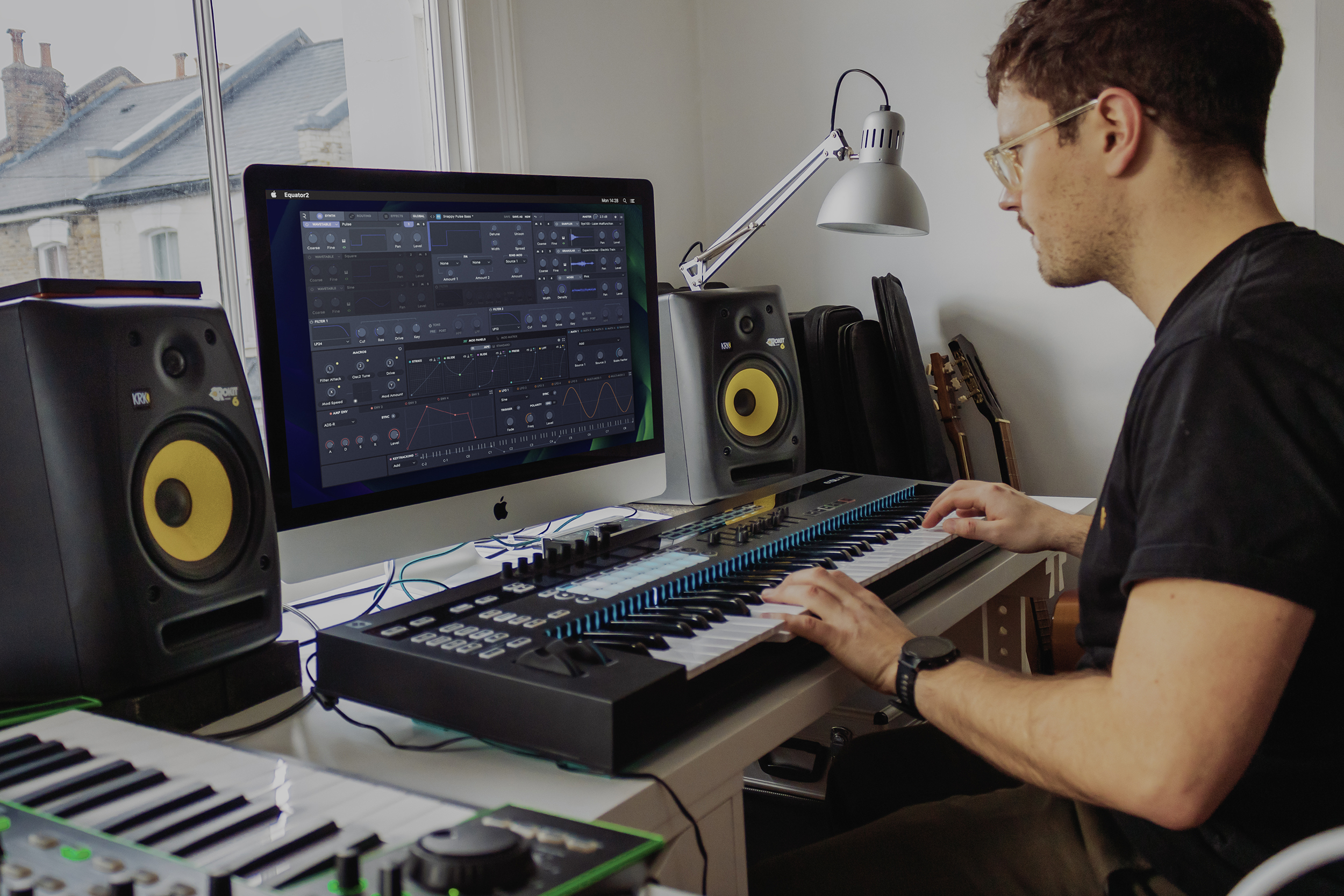
If you’ve got a home production suite or live rig with your favorite drum machines and DAW but need a little extra spice for your samples, you can’t go wrong with Equator2. The limitless hybrid synthesizer is packed with an extensive library of multisampled instruments ranging from vintage synths to orchestral strings, and you can easily drag and drop your own samples among those to further tweak and change for even more bespoke sounds.
But if you really want to take your sampling into the future, you'd better reach for Airwave. A natural progression from spinning LPs or finger drumming, Airwave brings back that hands-on magic, but instead of having two LPs containing the breakbeats or samples loaded to beat pads on a drum machine, you can assign and trigger your samples using one of the Air Gestures. This gives producers a chance to get into the flow of their performances and fire off samples with natural movements—perfect for making space for those happy accidents and musical spontaneity.
Suggested articles

The LGBTQIA+ roots of House — dance music’s most liberating genre
Music Production Tips and Tricks: How to Improve Performance Pt.1
Explore Airwave with quick tips and creative tricks
No matter how you like to make music, these production tips will improve performance on your devices.
Join the ROLI community