Why perfectionism is the enemy of progress
Here’s how you can learn faster, go further, and have far more fun by embracing imperfection.
Perfection, when it comes to learning piano, is a trap. By striving for a perfect performance, the perfect technique, or even the perfect way to learn, we risk stunting our progress and ending up further away from those ideals than had we never tried at all. And we might not even realise we’re doing it.
If you’ve ever been disheartened by a mistake or a perceived flaw in your playing, been too shy to play within earshot of others, or perhaps put off starting to learn altogether, you may just be a perfectionist. It’s nothing to be ashamed of, and incredibly common among beginners and experienced players alike. “Practice makes perfect,” right?
The bad news (and the good news too, as we’ll see) is that there’s no such thing as perfect when it comes to music. And the belief—conscious or otherwise—that there might be can keep us stuck in all sorts of sneaky ways.
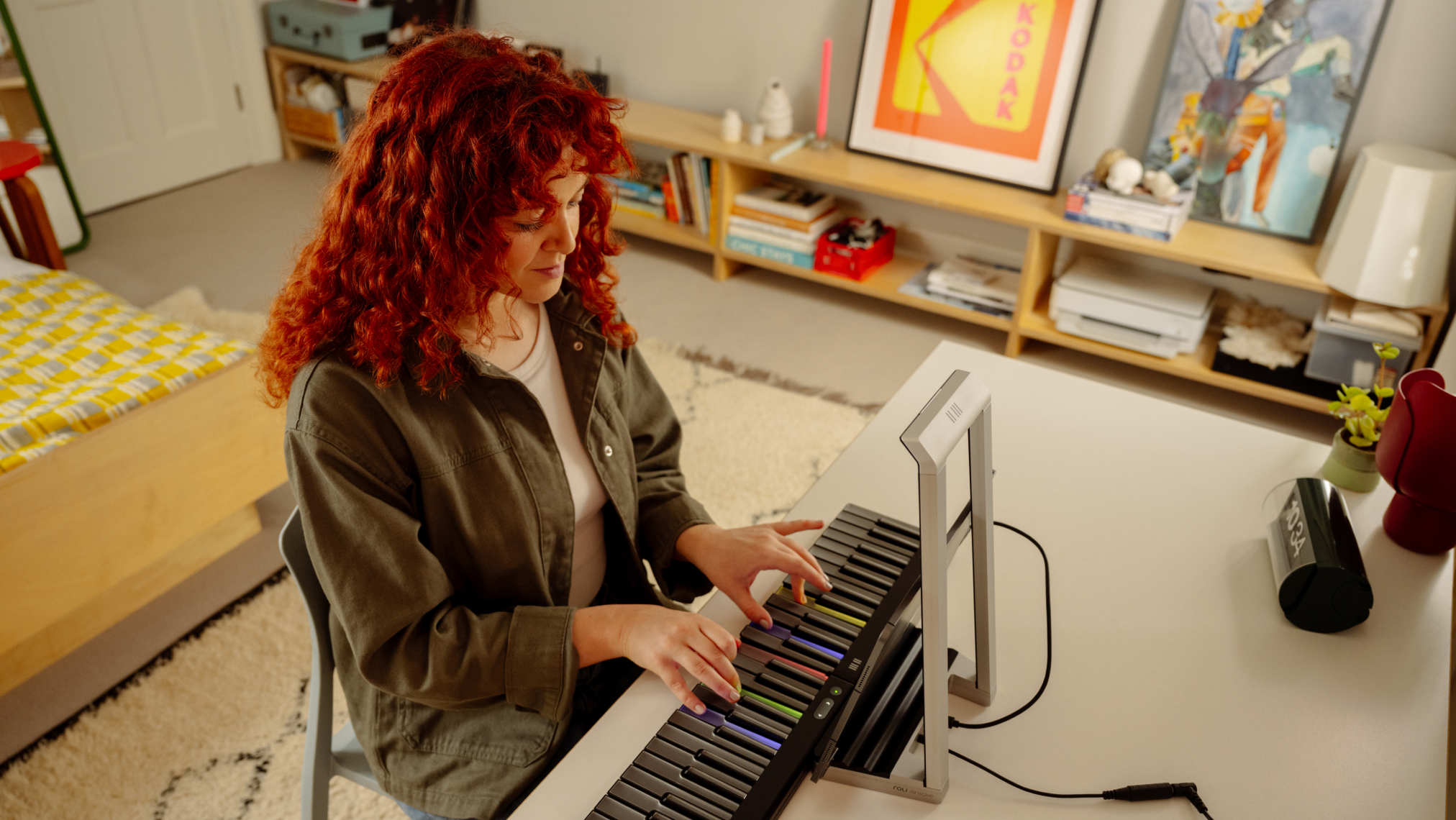
The problem with “perfect”
For something that doesn’t really exist, perfection certainly seems to wreak havoc among piano learners, regardless of whether we’re taking our first foray into music, returning after a long break, or picking up a second (or third, or fourth…) instrument. In actuality, learners who have more prior experience can be even more susceptible, thanks to the weight of their own expectations and identity as“a musician”.
“Perfect” is a convincing and seductive illusion. It can serve as a neat bullseye at the center of all aspects of our musical practice, whether we’re learning an instrument, making an album, or even shopping for a new instrument. It’s a label we might apply to our favourite musicians, albums, or performances, and an ideal that we strive to one day reach with our own playing.
Even within our own ROLI Learn app, it’s possible, with practice, to score 100% for a given performance of a song. Does that mean you played it perfectly? Well, no. Sorry. It means you played all the right notes, at the right time, in the right way. It’s something to be proud of, without a doubt, and a great way to measure your progress and stay motivated to learn — but there’s more to music than accuracy.
The problem comes when we begin working towards perfection. The idea itself can be so overwhelming that it resigns us to inaction, preventing us from even beginning to make meaningful progress. If we can sidestep this particular pitfall, we’re still playing a losing game; the closer we come to the perfect performance, the perfect playing technique, or whatever particular ideal it is we’re fixated on, the more clearly we see that there’s always an improvement to be made: our timing could always have been slightly tighter, our technique slightly more efficient, or our dynamics a little closer to what the composer intended (and just how precisely can that be measured?).
The result is that we end up chasing a receding musical horizon. What initially looked like a worthy goal eventually erodes our motivation.
Faced with this inevitability, we have a choice to make — on one hand, there’s self-doubt (“I’ll never be good enough!”) and on the other, we have obsession (“I have to become good enough!”).
Or we can reject the notion of perfection altogether.

The perfection of imperfection
It’s not just that we can never really play anything perfectly. Were it humanly possible to achieve this sort of perfection, we’d find pretty quickly that it wasn’t really worth the effort.
"Don't be afraid of mistakes,” Billy Joel once told Rolling Stone. “Because the only original thing we ever do is make mistakes. You can be taught how to do something perfectly right, but only you can screw it up in your own inimitable way."
What he’s getting at here is the idea that it's the imperfection inherent to all human performances that keeps things interesting — and beyond that, it’s what defines your personal style.
If two jazz pianists could both play the same standard perfectly, they’d both play it identically — and we could save ourselves some time by only listening to one of them. We know in practice that it doesn’t work like this; we want to hear our favourite performers play the music we love the way that only they can play it. This becomes even clearer in the case of live music — if we just wanted to hear the music exactly as we’d heard it before, we could listen at home and save some money, too.
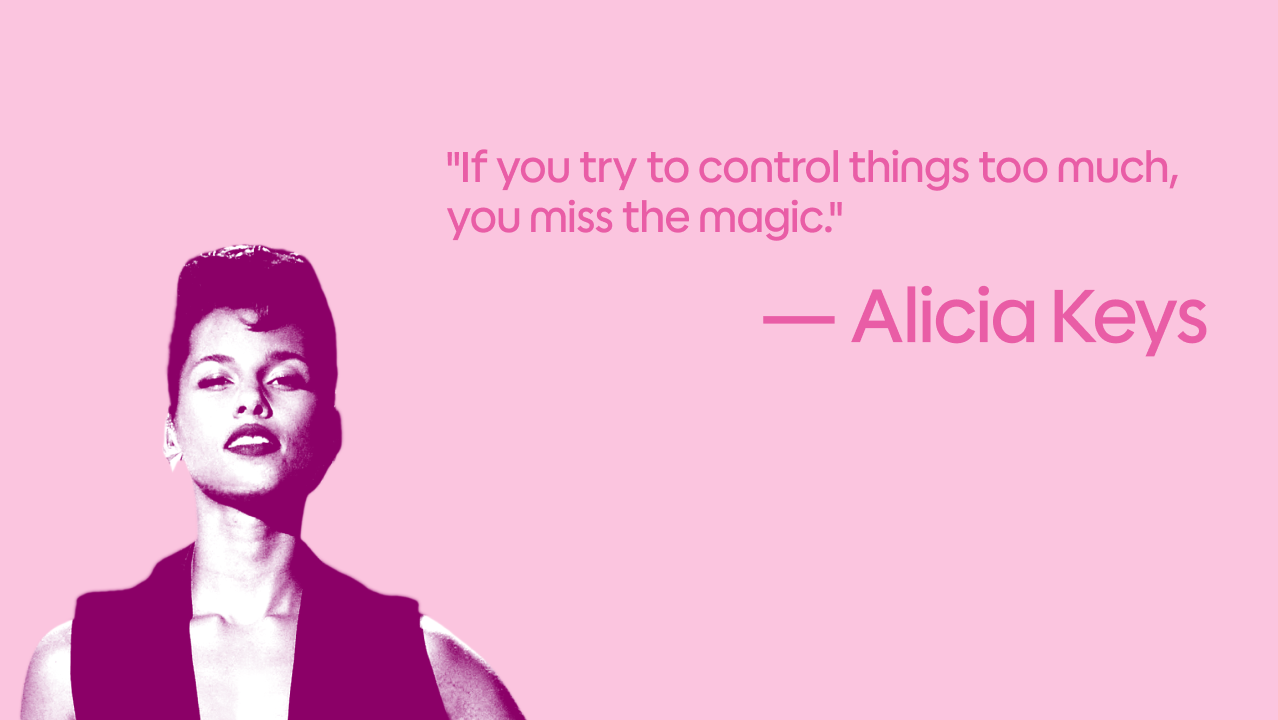
It’s not just the piano man himself. Alicia Keys, too, sees the value in embracing at least the possibility of imperfection: “If you try to control things too much, you miss the magic,” she once said. And the very first card written for Brian Eno and Peter Schmidt’s Oblique Strategies card deck? “Honour thy error as a hidden intention."
The world of music is replete with stars who are revered, at least in part, for their deviation from technical perfection or conventionally “correct” technique: J Dilla changed the sound of hip hop almost single-handedly by tapping beats into his sampler with a timing so intentionally loose that it could only have been crafted by a human. Jimi Hendrix influenced multiple generations of guitarists while pushing the limits of volume with an upside-down guitar (that was occasionally on fire). And pop and R&B charts are still filled with more or less successful imitations of Billie Holiday's bent notes and behind-the-beat timing.
In all the above cases, the “flaws” encompass much of what we hear and understand as expression, which, unlike perfection, is very much a musical ideal worth working towards.
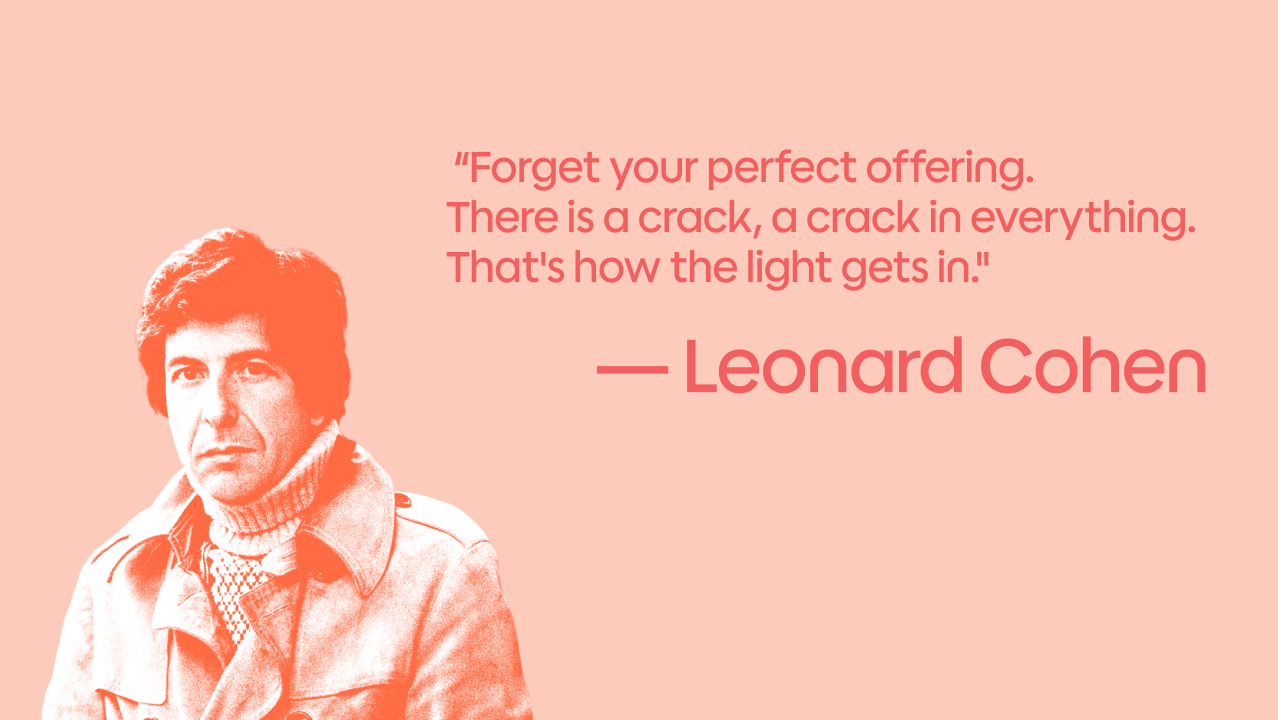
Perhaps the best summary comes courtesy of Leonard Cohen, an artist who spent months, years, and entire notebooks agonizing over the lyrics of a single song. 1992’s “Anthem” contains the following lines, delivered in Cohen’s inimitable (yet technically-imperfect) baritone:
Ring the bells that still can ring,
Forget your perfect offering,
There is a crack, a crack in everything,
That's how the light gets in.
Given that this song reportedly took a full decade to write, we should probably take his word for it.
How to stop being a perfectionist
If the problem stems from the fact that there’s no such thing as perfection in music, so does the solution: Let it go. Play the wrong note first. Perform for your friends before you’re ready. Sing along, even if your cat, spouse, or roommate hates it. Leonard Cohen said so.
But does that actually help us improve? Yes — and here’s how.
The flip side to the “practice makes perfect” mantra is the almost-as-oft-repeated “done is better than perfect.” But, as we’ve established in a previous post, there’s no real “done” state when it comes to learning a musical instrument. For many of us, and certainly for the superstars mentioned above, it’s a lifelong journey. So let’s revise the wording slightly: doing is better than perfect.
There’s a story, relayed in the book “Art & Fear” by David Bayles and Ted Orland, about a ceramics teacher who understood this point perfectly. On the first day of class, he announced he’d be dividing his students into two groups; the first would be graded solely on the quantity of pots they made, the other solely on the quality of pots they made. To get an A, students in the first group needed to create a great number of pots, while those in the second group only needed to create one “perfect” pot.
Counterintuitively enough, the best pots were all produced by students in the first group. They worked consistently, learned from mistakes, and iterated their way to better pots almost without trying (or at least without their grade depending on it). Students in the second group, Bayles and Orland report, spent a great deal of time thinking about the perfect pot, but failed to realize a single one between them.
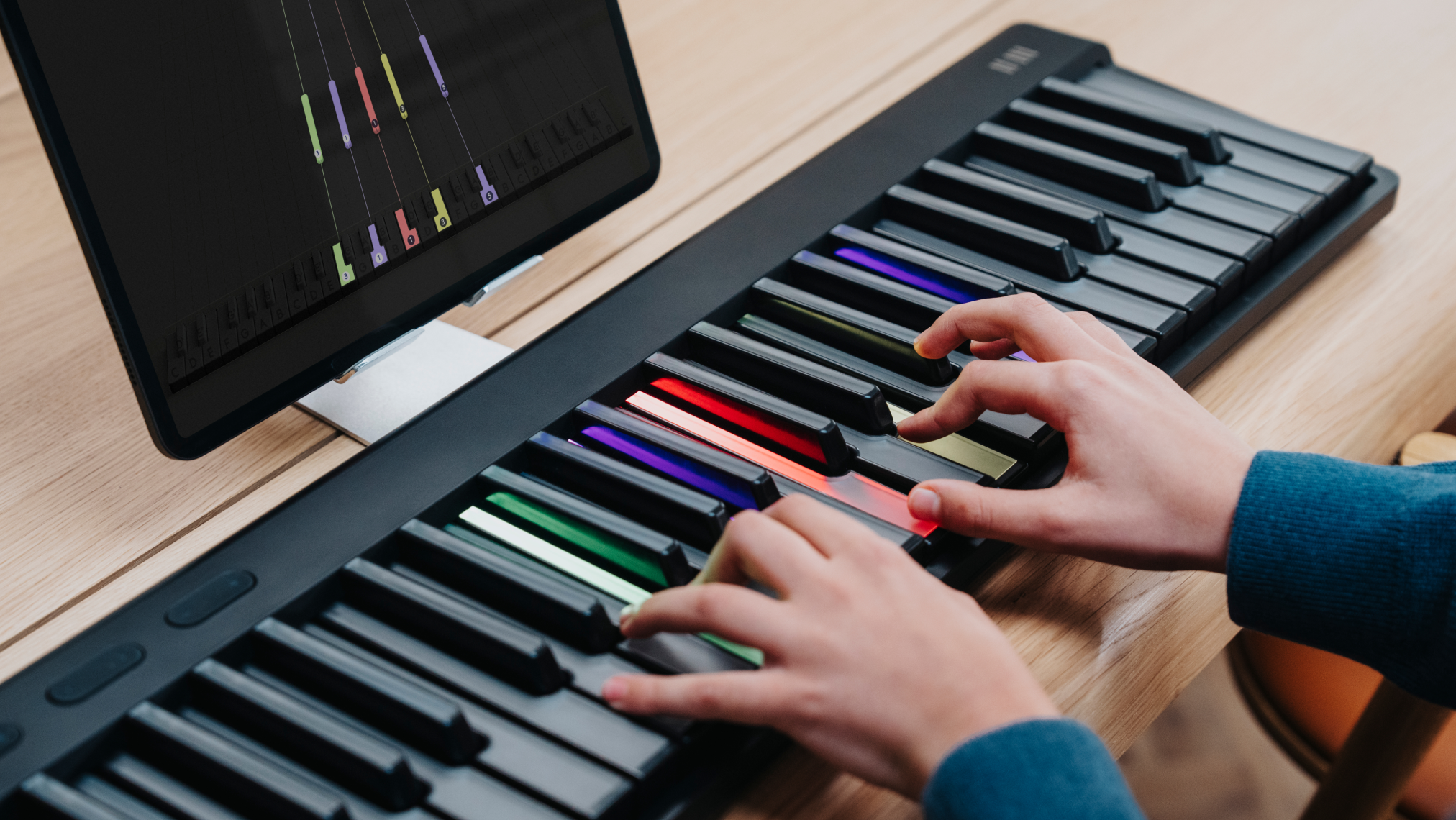
To translate the analogy to music, you’re better off learning lots of songs imperfectly than agonising over the intricacies of one particular song. And you can test this for yourself: Learn a song you like in the ROLI Learn app, but don’t sweat the small stuff. Just get to the point where you can play through it from beginning to end without too much difficulty. Take a screenshot, or note down your scores, but don’t worry about them at this point — we’re simply establishing a baseline.
Step two is to forget all about it. Don’t give it any more thought until you’ve learned a few more songs — four or five should do it (provided you don’t get hung up on “perfecting” these either).
Only then, go back to your original song. Allow yourself a couple of runs through it to re-familiarize yourself and warm up those fingers, then play it once more and see how your scores compare to your original attempt. You’ll very likely see real, measurable progress without having spent any time at all actively trying to improve at that particular song. And we’ll bet you’ve learned more overall and had far more fun than you would have otherwise.
Now, the next time you find yourself fixated on the finer points of a particular performance, a playing technique, or even a tricky lesson topic, try simply doing the best you can in that moment, and moving on anyway. Turn your focus to other songs or lessons, and look for more reliable motivation like having fun, finding interesting new challenges, or feeling your way through a familiar song in a new way — remembering that it’s your unique imperfections that make your playing sound like you.
The perfect (enough) way to start learning piano
Ready to make some mistakes? Pair ROLI Piano or Piano M with a subscription to the ROLI Learn app and start learning along with your favorite songs today. You also get access to interactive video lessons with real teachers, engaging games and exercises, and an AI Piano Assistant that’s always on hand with advice and encouragement.
Add Airwave, and the whole system gets even smarter — it watches your hands as you play to provide real-time feedback on your technique.
Join the ROLI community