Ready Player One? Play along to video game music in ROLI Learn
Beat your piano learning high scores with your favorite game soundtracks
Many of us will have a core memory locked away somewhere deep in the recesses of our minds that comes hurtling to the surface whenever we hear the sounds of a beloved video game soundtrack. From Super Mario Bros. and Sonic the Hedgehog to Grand Theft Auto and Undertale, video game music has transcended beyond the confines of the pixelated on-screen worlds and into our daily listening.
The evolution of video game music has been structurally tied to the hardware and instruments used to make it. While early video game music started with simple programming, it has since evolved into a multi-layered art form, combining genres such as electronic, rock, jazz, and funk, as well as powerful orchestral scores that evoke emotion.
The music has gone from a simple accompaniment to gameplay to something that defines the player’s journey, enhancing the experience by shaping our moods, heightening tension, and celebrating our triumphs and losses through sound.
From beeps to ballads
Early video game music was limited by hardware, requiring composers to use basic waveforms to create chiptune styles. Arcade games like Space Invaders (1978) and Pac-Man (1980) used short musical motifs as start-up sounds, but excluding sounds and music synced with player actions, gameplay was relatively sonically sparse. It was not until 1980 that Namco would release Rally-X, one of the first video games to feature continuous, melodic background music during gameplay.
Tetris (1984) was originally launched without music, but as the game's popularity expanded worldwide, each region later included musical choices of its own. The US Tetris release leaned into digital interpretations of Russian classical music, including Pyotr Ilyich Tchaikovsky's "Trepak" from The Nutcracker and Reinhold Glière's "Russian Sailor Dance" from The Red Poppy, which was also translated into the NES version of the game using Tchaikovsky's "Dance of the Sugar Plum Fairy" from The Nutcracker. The Game Boy version also featured German composer Johann Sebastian Bach's French Suite No. 3. However, the Russian folk tune "Korobeiniki" is the most widely known theme for Tetris. This 19th-century melody was given new life in 1984 and is now one of the most recognised melodies on the planet.
As we mentioned earlier, technology dictated what was sonically capable for video game music. CD-ROMs and MIDI music production enabled the creation of higher-fidelity tracks, which saw the rise of recorded orchestral instruments in video game soundtracks. The likes of Final Fantasy VIII, Metal Gear Solid, and Resident Evil 2 were at the height of a trend towards more film-like scoring, elevating game music to even more emotive and atmospheric heights, and inviting greater layers of sonic complexity.
How video game music works: scoring an emotional journey
It can be easy to trivialise game music as simply something in the background of gameplay, but the use of theme tunes, ambient sounds, and action cues makes game music as integral as the graphics on the screen. It shapes our emotions and heightens our immersion in storytelling, and is a crucial part of game design itself. Properly timed music and sound effects can create realism in games. The music makes the on-screen peril feel all the more real, lets players know when they’re on the right path, close to danger, running out of time or health, or have reached the path to victory. The power of game music is that it transforms a predominantly visual experience into a deeply moving and memorable one, where tension and release are guided by sound.
While game music can be classed as a genre of its own, it’s actually a genre with a complex palette of sonic references. Many game soundtracks have borrowed from countless genres, including classical music, pop, jazz, funk, synthwave, ambient design, and industrial noise.
In recent years, the classical music world has been revitalised by video game music, with sold-out orchestral events attracting gamer communities and lovers of lush orchestration alike. On a much smaller scale, there’s also been a trend towards live bands playing at gaming events, most notably Marioke, where a live band accompanies racers, playing each course’s soundtrack (complete with countdowns, power-ups, and finish line melody changes).
From pixels to piano: learning to play your favorite video game music
So you've clocked in hundreds of hours playing RPGs, clearing level after level and stage after stage, but putting in as many hours to play those beloved soundtracks and music from video games might seem like a tougher battle. And while there's no cheat code to mastering the piano, ROLI Learn makes it a lot more fun. Using the ROLI Piano System, you might find it's a familiar world of visual guidance and coordination, geared towards playing and learning music. In AI Music Coach, you'll have the voice of a helpful guide by your side, giving you tips and tricks when you need them. With easy steps, you can learn to read music, understand rhythm, and develop your own sense of musicality. Think of it as Guitar Hero for piano lessons.
Game START! Play along with your favorite game music in ROLI Learn
Just like your favorite games that kept you coming back for more, in the ROLI Learn app, you can choose one of your favorite game soundtracks and level up your piano skills.
Tetris Theme (Traditional)
While we all know it as The Tetris theme, the Russian folk melody "Korobeiniki" is the real title of the theme to the world-renowned and beloved brick puzzle game. This song is a great challenge for building right-hand dexterity and rhythmic precision.
Minecraft – C418
Moving on from 2D bricks to 3D blocks, the gentle and ambient sounds of Minecraft music is an emotionally resonant touchstone for an entire generation of gamers. Playing along to this piece will help you understand how mood and dynamics can build and absorb you in gameplay, even when the chord progression is relatively simple.
Dearly Beloved from Kingdom Hearts – Yoko Shimomura
Legendary Japanese composer Yoko Shimomura is a master in the art of video game composing. Her career spans works including Street Fighter II, Super Mario RPG, and Final Fantasy XV. We’ve got a fan favorite from the iconic Kingdom Hearts series available to play in the Learn app, the aptly named ‘Dearly Beloved’.This recurring motif across the entire Kingdom Hearts series is a masterclass in lyrical piano playing and Japanese RPG compositional hallmarks. If you want to really understand how legato and beautiful phrasing work as an emotional trigger in video game music composition, this is the piece for you.
The Last of Us – Gustavo Santaolalla
Two-time Academy Award winner for Brokeback Mountain and Babel, Santaolalla’s score for The Last of Us takes a minimalist approach, using sparse, haunting guitars to channel true suspense and isolation. If you’re not a gamer, you may be familiar with the HBO series adaptation, which brought Santaolalla’s compositions to an even wider audience. If dystopian themes are more your thing, this is a great piece to try, packed with emotional depth.
Baba Yetu – Christopher Tin
In 2011, “Baba Yetu” from Civilization IV became the first video game song to win a Grammy award for ‘Best Arrangement, Instruments and Vocals’. Interestingly, the piece was originally written in Swahili and was based on the Lord's Prayer. While it may seem a bit more complex, this piece is a more motivating choice for learners who want to challenge themselves with a more unconventional video game soundtrack.
Megalovania – Toby Fox
The soundtrack for the viral internet sensation Undertale was written by Toby Fox when he was just 19. The song itself has a legacy of its own, becoming one of the most-covered songs of the soundtrack due to its complexity. If you're an intermediate player looking for a tougher challenge, you can try tackling “Megalovania” from Undertale. It's more of a rhythmically demanding piece, but a great next step that gives you a strong sense of achievement once you nail it.
Angry Birds Theme — Ari Pulkkinen
Angry Birds is one of the most successful mobile games in history, with over 4 billion downloads, and its instantly recognisable theme is one of the most-heard pieces of music of the 2010s, referenced from online content right through to television shows. The jaunty ditty will be a delight to learn to play for those looking for something more light-hearted to master, with a few rhythmic challenges to keep you on your toes (or should we say fingers?)
Dragonborn from Skyrim — Jeremy Soule
The Skyrim theme employs a 30-person choir singing in the fictional Dragon language known as Dovahzul. With over 30 million copies of Skyrim sold, this theme is one of the most recognisable pieces of video game music ever written, with its combination of Dovahzul chanting soaring over a rich orchestral foundation.
Assassin's Creed III & Revelations by Lorne Balfe
With Hollywood film credits including Mission: Impossible – Fallout, Black Widow, and The Batman, Lorne Balfe’s work for Assassin’s Creed brings the grandeur of the big screen to the small screen, but there’s nothing small about his sound. It’s packed with intensity and a strong, propulsive energy that keeps you hooked. The Scottish-born composer also studied under none other than Hans Zimmer.
Pokémon Theme
Okay, we’re cheating a little with this one, but we couldn’t omit the original Pokémon theme from our list — even if it is the one from the anime. Pokémon’s origins are in the video game world, starting back in 1996 when Game Freak released the RPGs Pokemon Red and Pokémon Blue. The success of the games led to an anime adaptation in 1997, and well, the rest is history. John Siegler’s theme tune for the series is one of the most culturally important and instantly recognisable pieces of music of the 1990s, and one of the most adored by children and nostalgia-prone adults alike.
Suggested articles
Learn piano with film scores by John Williams
Learn piano with Grammy-nominated artists from the ROLI Learn library
Learn piano with Olivia Rodrigo and The Beatles
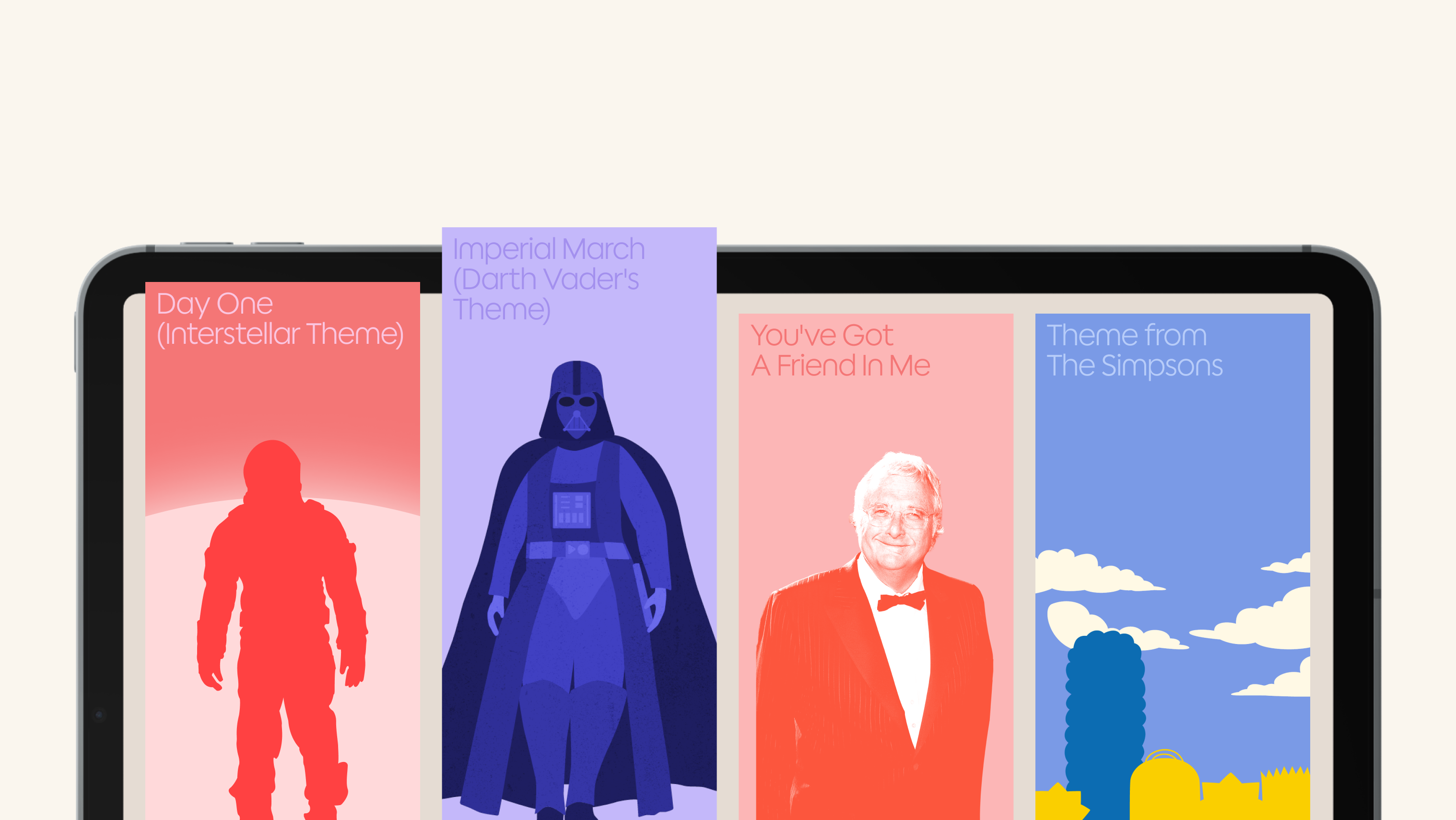
Lights, camera, action! Learn piano with classic film soundtracks in the ROLI Learn App

What’s the best way for kids to learn piano?
Join the ROLI community