Reimagining the Suzuki Triangle: teacher, parent, child — and the emergence of the AI practice assistant
ROLI's Chief Content Officer Sophie Solomon reimagines the teaching practices of legendary violinist Shinichi Suzuki for modern music learners.
The Suzuki method was developed in the 1940s by Japanese violinist Shinichi Suzuki, who believed that musical ability could be nurtured in any child in the same way they learn to speak their native language. In Suzuki, children learn through listening, immersion, and daily practice. Essential to the method is its triangular structure: the teacher, the parent, and the child. This relationship is not merely logistical — it is pedagogical. Suzuki’s philosophy was grounded in the belief that ability develops through consistent daily practice in the right environment.
In Suzuki pedagogy, the parent acts as the “home teacher.” They attend lessons, take notes, and guide daily practice. Research in music education has consistently shown that parental involvement is strongly associated with increased practice frequency, higher motivation, and greater progress in young learners. The parent provides structure, accountability, and emotional regulation during the many hours of practice that occur between lessons.

However, research also highlights a structural tension within this model. Decades of motor learning research demonstrate that improvement depends not simply on repetition, but on informed repetition — practice guided by clear goals and immediate feedback. Unguided repetition leads to far slower progress. Within the Suzuki triangle, the parent is traditionally responsible for delivering much of this feedback during home practice. But while parents can effectively support the process of practice, they often lack the domain-specific expertise to support its content.
My own experience illustrates this vividly.
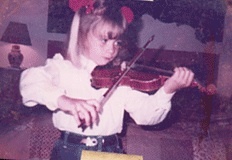
I began learning violin through the Suzuki method at the age of two. My mother was deeply committed and, since she did not work outside the home, was able to attend every lesson and support me to practise every day. However, she was not a musician and, in order to help me, developed her own system — a kind of personal code — writing notes to herself so she could remember what the teacher had said and what to listen for. This worked, for a time. But it was not long before my own understanding surpassed hers. Although she remained invaluable as a source of motivation and consistency, I soon outgrew her as a practice coach.

Years later, when my own children began learning violin through Suzuki, I experienced the triangle from another angle — as a parent. Unlike my mother, I am a professional violinist and so had the technical and pedagogical expertise to support their practice at a very high level. I could diagnose problems immediately and structure practice effectively.
And yet, even with this expertise, the time commitment was enormous.

Supporting two young children to practise daily — around school schedules, work, and family life — required sustained attention and energy. It was difficult to maintain consistently. Inevitably, I found myself prioritising my daughter’s practice, as she had started first and was already playing well. My son, left to his own devices, made slower progress and soon gave up. (Fortuitously, he later found his way via double bass and a brilliant school music department to the electric bass.)
This lived experience highlights the Suzuki method’s inherent dependency on two scarce resources: time and expertise.

A Modern Extension of the Triangle
This is where ROLI’s AI-based practice assistant (AI Music Coach) offers a compelling contemporary evolution of the Suzuki model.
Where the parent may be time-poor or lack musical expertise, an AI assistant can provide consistent daily guidance. It can help structure practice, remind the pupil of the teacher’s instructions, reinforce repetition, and support the formation of correct habits. In motor learning terms, it provides the kind of regular, augmented feedback known to accelerate skill acquisition and improve retention.
With this support, the learner is able to practise more effectively and independently, and the teacher’s pedagogical intent is carried more faithfully beyond the lesson itself.
The triangle remains — but it is no longer constrained by the availability or expertise of a single adult. It becomes more resilient. More sustainable. And more aligned with the realities of modern family life.
Importantly, the parent’s role is not eliminated. Research consistently shows that emotional support and parental valuing of music remain among the strongest predictors of long-term engagement. What AI changes is not the parent’s emotional role, but their technical and supervisory burden.
In doing so, it strengthens the very structure that made Suzuki so powerful in the first place.
Not replacing the triangle. But optimising and reinforcing it for a new generation.
About Sophie Solomon
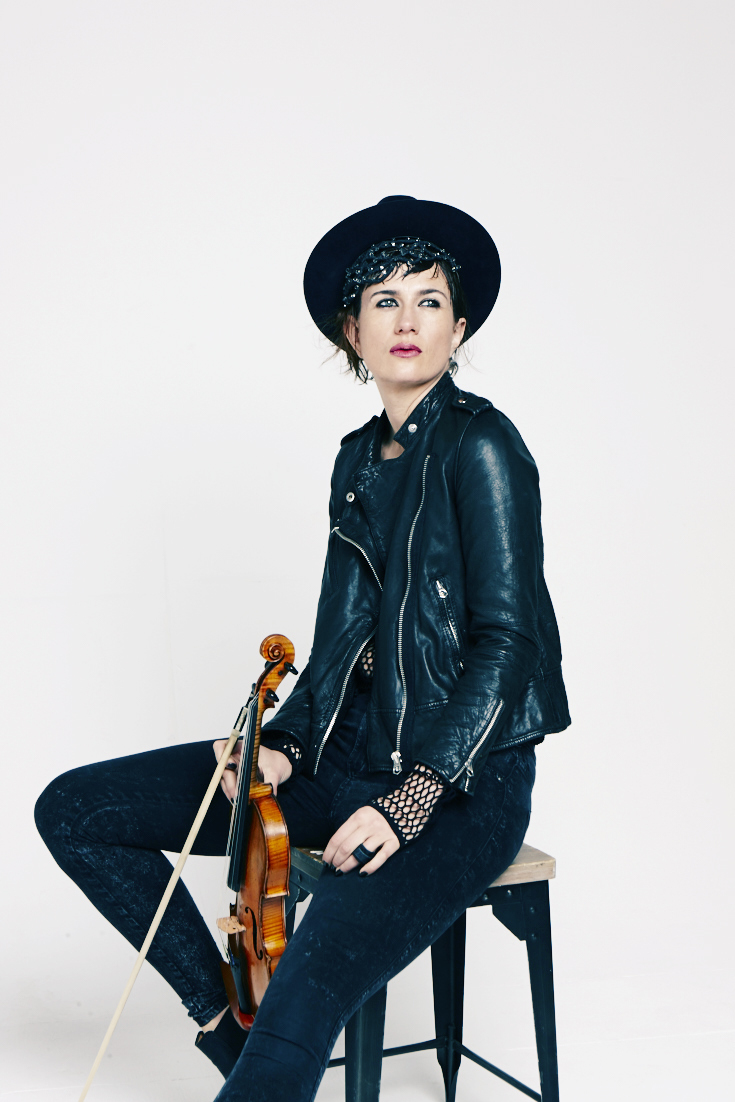
Sophie Solomon is Chief Content Officer at ROLI and is an award-winning violinist and composer. She has written music for the likes of the National Theatre, taught at the Royal Academy of Music, and toured the world playing with artists as diverse as Leonard Cohen, Rufus Wainwright, KT Tunstall, Paul Weller, and the London Symphony Orchestra.
Sophie believes that music is a human right. She is the founder of OFSTED Outstanding Hackney New Primary, a state school with a music specialism where music is on a par with literacy and numeracy, and every child learns a stringed instrument for free.
Join the ROLI community